Category: Review


The Apartment (1960)


Jack Lemmon, Shirley MacLaine, Fred MacMurray

Directed by Billy Wilder

Written by Wilder and I.A.L. Diamond

The Apartment, critical and commercial smash hit of 1960, is the progenitor to the romantic comedy and one the most perfect movies of its era, both in plot and in its characters.

After viewing the classic Brief Encounter in 1944, The Apartment director Billy Wilder had to wait more than a decade before film codes could relax enough for him to tell the story of the “third man”, the friend who lets reluctant but star-crossed lovers Trevor Howard and Celia Johnson use his flat for their brief encounters.

In his vision 14 years later enters the character of bachelor C.C. Baxter (Lemmon), a low-level worker in a giant New York insurance company, who is on the rise only because he generously lets out his swank apartment for use by his promiscuous bosses and their mistresses.

It’s such a lucrative business that he has to arrange these “meetings” in his day planner, to the point where most nights he sleeps in Central Park or doesn’t sleep at all. At work he flirts continuously with Miss Kubelik (MacLaine), the elevator operator with whom he is hopelessly smitten with, and he finally gets the chance for promotion when smarmy director Sheldrake (MacMurray) invites him to his office and asks if he can borrow the keys for the night.

It’s revealed to the audience that Sheldrake’s lover for the night is none other than Miss Kubelik, who is silly enough to believe Sheldrake’s promises of divorcing his wife and marrying her. Her realization that he is a liar causes her to nearly commit suicide by taking sleeping pills, a deed undone by the arrival of Baxter, who brings a bar girl to his apartment only to find Sheldrake gone and poor Miss Kubelik comatose on his bed. He revives her with the help of his Jewish doctor neighbor, and Baxter spends a few days in heaven taking care of her before they have to go back to their separate lives.

This sets the stage for the conclusion’s questions – whether or not Miss Kubelik will choose suave but untruthful Sheldrake or wholesome but goofy Baxter – and the ending is as resolutely satisfying as it is sweet.

Lemmon, easily in the top tier of all-time American actors, adds his considerable comedic talent to a dramatic role that required a sensitive, well-meaning jokester. How natural his acting is, and the way he chooses to deliver his dialogue’s lines are inimitable, while his ad-libs of some of Wilder and I.A.L Diamond’s screenplay were so pitch-perfect that they replaced the original script’s lines.

MacLaine stole several filmgoers’ hearts as the cute and vulnerable, pixie-like Miss Kubelik, who not only holds her own against both of the wildly-different male actors, but creates a zestful chemistry with Lemmon throughout the picture.

The film’s theme, written by Charles Williams, is a beautiful sweeping melody, which at first seemed over-the-top considering the comedic element in the first hour. But tackling the previously unheard-of themes in a major picture – like flagrant, encouraged infidelity and attempted suicide – the score takes on more meaning and accompanies The Apartment’s lovely ending perfectly.

Of all of the romantic dramas of that decade, no male lead is more believable and real than Lemmon’s C.C. Baxter, and very few films have been as perfect a comedy-drama at The Apartment.

Images courtesy of brittanica.com and vintagefilm.typepad.com, respectively.


Robert Mitchum, Shelley Winters, Lillian Gish

Directed by Charles Laughton

The Night of the Hunter is one of the most surreal and unique films of the 1950s, and features Robert Mitchum as a menacing, homicidal fake preacher who depicts his character’s sociopathic tendencies, greed and barely-there patience with alarming alacrity.

Bank robber Ben Harper (Peter Graves in one of his earliest roles) leaves the knowledge of the treasure trove’s location to his son and daughter moments before his arrest. Awaiting the electric chair, his bunkmate is the seedy Harry Powell (Mitchum) who finds out Harper’s giant mystery and takes it one step further by wooing the Harper’s naiive and foolish wife (Winters) following his execution. While Harper’s wife may be duped, his son – played wonderfully by Billy Chapin – is certainly not, and stands firm along with his sister even when assaulted, threatened and manipulated by Powell.

Eventually, Powell’s guise as a holier-than-thou, friendly preacher can’t be kept up by him anymore and he murders his new wife. With no one to stop him now, Harper’s children flee and embark on a fantastical journey through the swamps and rivers of the South, finally found and taken in by Rachel Cooper, a widow who cares for small children (Gish). Stalking the children, Powell finds the Cooper household and masquerades as the children’s father. Not like the weaker women Powell is used to, Cooper trains a gun on him, telling him to leave. Not to be forgotten, Powell vows to return, and when he does it sets up a wild and satisfying conclusion.

Hunter plays like an adult fairy tale, with themes more mature and advanced than most others of its time period. The script, co-penned by James Agee and Laughton, references the Bible on numerous occasions, and the irony imposed by the hypocritical Powell (who loathes sexual desire, a feeling he combats by murdering women he fancies) by quoting the scripture endlessly and often incorrectly is palpable. He brainwashes his new wife with his bogus Christianity, and endears an older couple (the old busybody played with annoying success by Evelyn Varden) with his false charm. Powell represents a familiar Evangelical – devout, set-in-his-ways, and with a Southern lilt – that also is one of the worst villains in screen history.

The relationship between Powell and the Harper children are realistic and unsettling, especially in several scenes of dialogue where Powell alienates the boy from his sister to get her to tell him the location of the treasure, something she promised never to divulge. This scenes showcase Mitchum’s incredible range and talent, where he puts on the menace and charm in charismatic heaps.

The cinematography by Stanley Cortez uses elements of German  Gotchic expressionism to create bizarre set design with sparse lighting and long, creepy shadow effects. It’s incredibly affecting, particularly in the scenes that show the tall, dark-hatted Mitchum materialize seemingly out of nowhere. The fantastical scenes of the children drifting along the river in their boat, being watched by toads and rabbits as they slowly meander along are a visual treat, and are scenes completely unique to Hunter.


At the film’s end, Cooper stands sentry in her house on her rocking chair, gripping a rifle. Powell is heard off in the distance, singing the haunting melody of “Leaning on Everlasting Arms” and he begins to stalk along the perimeter of the her gate. Cooper then begins to sing along with him, but instead of his ominous, deep-voiced tone of his voice, hers is uplifting and joyful – the way God, if he exists, would have wanted it to sound – and Powell promptly shuts up.

Images courtesy of guardian.co.uk and filmforno.com, respectively.


Errol Flynn, Olivia de Havilland, Basil Rathbone, Claude Rains

Directed by Michael Curtiz, William Keighley

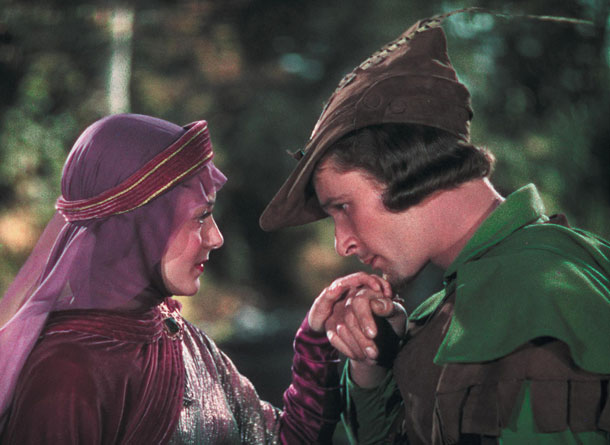
Incorporating (and advertising) the relatively new filmmaking medium of Technicolor, The Adventures of Robin Hood (Warner Bros.’ rival MGM had the rights to the title “Robin Hood”) is probably the first genuine adventure epic in the vein of what we are used to today: bold, honest characters standing up for the good of all men in the face of greedy, evil ones, a beautiful maiden that steals the heart of every man both in the film and in the audience, a rich, much-detailed array of sets featuring exhaustible art-direction, and a gorgeously rendered score that brings out emotions for romantic parts, and heightens the suspense during scenes of great action.

It stars the inimitable Errol Flynn as the title character, who portrays Robin as an endearing trickster, a deadly swordfigher and archer, and a handsome, dashing ladies’ man all rolled into one – the direct progenitor to leading men like Harrison Ford and Tom Cruise.  His foil is Basil Rathbone, better known for his stoic, unflinching portrayal of Sherlock Holmes, as Guy of Gisbourne, the ruthless and nearly homicidal henchman of King John – smarmy, slippery and effete as only Claude Rains could play him.

Modern filmgoers will know all they think they need to know of the Robin Hood story from the Disney imitation, the quite spectacular Robin Hood: Prince of Thieves (1991) picture, and the failed attempt at a re-realization that was Ridley Scott’s Robin Hood from this year, so I will state only that in this version the King of England, Richard the Lionheart, is being held in Austria.  In his stead, slimy Norman King John and his pal Gisbourne are taxing and murdering the Saxon populace to such an extent that Sir Robin of Locksley and his pals are forced to go into hiding as outlaws, to “steal from the rich and give to the poor” until Richard’s return.

Flynn’s Robin is a revelation in how the choice of casting the lead star can alter the entire film’s production.  His athleticism, the quips and brilliant jests the script gives him, and the subtle but beautiful and emotive ways he romances de Havilland’s Maid Marian  let him quite easily own the film.  And the sets, both on the studio lot in Hollywood and in the forested canopy of Chico, California ( a better Sherwood Forest than Sherwood Forest could ever look like) are his playground.  He romps, rides, skips, swings and dashes through it with all the masculine grace that only a bonafide star could achieve.

But none of this could be as much of a success as it was without the magic of Technicolor, something I feel makes movies like Adventures and Gone with the Wind (1939) look less dated than ones released twenty years ago.  The brightest colors I have ever seen are reflected in the reds and blues of Norman flags and the bright green of Errol Flynn’s ridiculous tights.  Everything is a revelation to view, and quite definitely is something that will never be able to be filmed again.

It’s all too-easy to disregard the swashbuckling costume-laden fun of The Adventures of Robin Hood as dated, hackneyed and laughable – the sped-up swordplay more farce than suspenseful, the sets too lavish and the good/evil types too obvious and tacked on, but that mindset ignores the good fun of what a classic adventure story is.  The Adventures of Robin Hood is seminal; the best production of its kind ever made.  It doesn’t strive to be the epic it isn’t, it doesn’t fret about ignoring or suspending the myriad conflicting fables of Robin Hood through generations past, and it makes no apologies for its predictable plot and happy ending.  An adventure tale should make you “ooh!” and “ahh!” at the vivid colors and stunt work, gasp at the beautiful, sensuous romance and should leave you with a smile on your face.

In the dark-minded perception of our new millennial generation, negativity seems to parallel reality, and from the state of the world such a mindset isn’t a false one.  But films are parables, are fantasy, full of the romance and comforts one can’t experience in real life.  This is why people went to picture shows, to film parlors in the time of Errol Flynn, to escape harsh reality.  Back then people praised filmmakers for giving them the fantasy and adventure, the romance and the happy endings they would never experience in their lives.  Now those same filmmakers get accosted for suspending reality, for being predictable.  I for one yearn for a time that saw the creation of The Adventures of Robin Hood, when a film could be fun and entertaining without worrying about what realism it might be compromising.

Images courtesy of www.grouchoreview.com, www-tc.pbs.org


Directed by Peter Bogdanovich

Written by Bogdanovich and Larry McMurtry; adapted from McMurtry’s novel

Timothy Bottoms, Jeff Bridges, Cybil Shepherd, Cloris Leachman, Ben Johnson

In small town Anarene, Texas, life is bleak for everyone.

For the high school seniors, sporting the worst football season in the town’s history (“Don’t you boys know how to tackle?”), there isn’t much to look forward to besides oil work – unless you’re a Wichita Falls country club kid bound for college in Dallas.  And for the townsfolk themselves, any hope they once had of realizing their dreams has since faded.

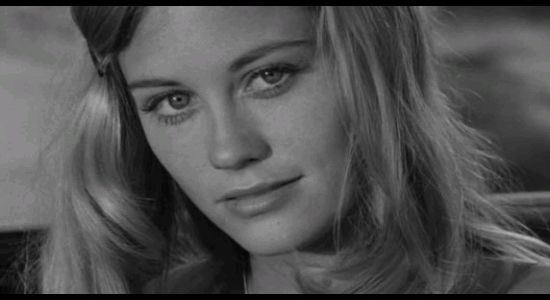
Graduating seniors Sonny (Bottoms) and Duane (Bridges) are half-brothers, Sonny in a relationship so mundane and pointless the anniversary present he gave himself was a break up, and Duane smitten hopelessly with Jacy (newcomer model-turned-actress Shepherd), who herself is just concerned about losing her virginity.

These young actors represent the new generation of this drama, set in the late 1950s, and contend and mingle with the older generation of lost youth and forgotten promises.  The latter consists of Ben Johnson’s Dan the Lion, who owns the picture show, pool hall and diner that the young folk propagate, and Cloris Leachman, an ill and unhappily married housewife who begins an affair with Sonny.

Johnson put his tough-guy, Wild Bunch-style bad company bandit persona to the side to strongly play a man yearning heavily for his past, watching with sadness the town’s youths living their lives without a care while he can only sit back and reminisce fleeting romances and missed opportunities.  His picture show is the only source of solitude for the young Sonny, whose own sadness and uncertainty carries the film as its main character, watching the world around him crumble as his life takes turns to nowhere.

Underneath the small town’s depressing and interconnecting lives is an undercurrent of sex, where nearly everyone shares someone’s bed.  Slightly dumb Duane doesn’t realize the only reason Jacy kept him around was for him to take her virginity, maybe then allowing her to join the upper crust inner circle of her social peers that frown at such prudishness.  When he fails at this, Jacy takes the lover of her disenfranchised, unphased mother – played by a frosty Ellen Burstyn – and realizes that apparently there is more to life than worrying about sex.  Eager to be loved again, Jacy cons the naive Sonny into leaving pitiable Cloris Leachman for her, but loses interest during their brief elopement.

Sonny meets up with Duane again before Duane leaves for Korea, their first meeting following a fight over Jacy that left Sonny with a broken bottle to the head.  The local theater is playing one last movie before its close – due to lack of interest from local kids – and Sonny takes Duane to it.

Red River is the last picture show, that beautiful Mutiny on the Bounty – Western parable with Montgomery Clift as the kind son to father John Wayne’s ruthless cattle baron.  Following Duane’s bus in the morning, a tragedy causes Sonny to speed out of town before coming back to visit the spurned Cloris Leachman, who reveals how much she loved him but how she has already “turned the corner” and he’s too late.

Gentle panning over the desolate, closed shops of Amarene’s main street towards the decayed movie theater ends the film, and we’re left feeling the choking sadness that plagued the film’s characters, young or old, throughout the picture.

The Last Picture Show was nominated for eight Academy Awards, populating the supporting actor categories with Bridges and Johnson, and Leachman and Burstyn in their respective groups, with Bottoms inexplicably absent in the Best Actor category.  Johnson and Leachman won their categories, Leachman’s performance to me being the most powerful, that of a haunted, insignificant housewife falling for a young boy and then being jilted for a younger, more beautiful girl.  Her ending outburst –cum- affection is my favorite scene in the movie.

Images courtesy of washingtonpost.com and acephotos.org, respectively.


Javier Bardem, Scarlett Johansson, Penelope Cruz, Rebecca Hall

Written and Directed by Woody Allen

Woody Allen’s affections for England and its complicated (and apparently murderous) social scene has come through in his last three films, but he travels south in Europe for this naughty, sexy romp that details a summer two American friends come to Barcelona and find themselves in a situation that makes them question their own stance on love and relationships.

Impossibly gorgeous Scarlett Johansson (a quote from Bernardo Bertolucci, director of The Dreamers comes to mind, where he called starring actress Eva Green “so beautiful it’s indecent”) is Cristina, free-spirited, often blithe and unwilling to compromise her non-traditional feelings on the silliness of love.  Her friend from college is soon-to-be-married Vicky, played by Rebecca Hall, a pretty, reservedly traditional girl who tends to say things like “guys, let’s not get into one of those turgid categorical imperative arguments”. Her deceptively cliché part is mainly due to Allen’s role-writing, but the only thing that’s turgid (synonyms include pompous and pretentious, words already that are rampant in the film’s dialogue) is to assume that twenty-something college girls talk like that.  But scripts were never meant to perfectly reflect how we actually talk.  How boring would that be?

At a restaurant the two of them are greeted by Juan Antonio, played by Javier Bardem, who makes a startling and frank offer.  From here the film embarks on a torrid and often-strange sex adventure that embroils the two Americans into the life of Juan Antonio and his old flame, Maria Elena, wildly portrayed by Penelope Cruz, for which she won the Best Supporting Actress Oscar in 2009.

Juan Antonio is casual, frank, and unapologetic about the bohemian life he lives and what he wants out of it, which Bardem channels wonderfully. And although he feels free to live his life the way he wants, he is constantly recalling his ex-wife and eternal flame, Maria Elena, who stabbed him the last time the two fought and ended their relationship.

Johansson and Hall do their jobs well, but no chemistry is as explosive as that of Bardem and Cruz’s, two Spanish actors familiar with each other and completely in their element.  Cruz, who I always felt was bogged down by bad translation in her English-speaking roles, shines here as Maria Elena, a raven-haired dynamite of a woman possessed and impassioned by nearly everything she does and, like Juan Antonio, is never apologetic for it.

As the plot thickens and begins to leave viewers wondering just how it will end, and just who Bardem will end up with, I thought back on the last Allen film I had watched, Cassandra’s Dream, and feared that a tacked-on, rushed ending would cheaply wind up the ending.  But Vicky Cristina Barcelona, while not what I would call a deep film, is intriguing in its delicate little unforeseens.  Vicky is made out to be the predictable one at the film’s outset, having already structured her life and going through any and all lengths to stay in her comfort zone while in Barcelona – but it’s really Cristina who is the predictable one, whose nonconformity and purposeful unconventionalism in love and life is really a transparent , immature façade that shows itself at the film’s conclusion.

And the very ending, where Vicky, having always been smitten with Juan Antonio, goes to his casa and nearly falls prey to his advances and her yearnings, is wonderfully unpredictable and imaginative. The last two mentioned adjectives are always what I look for in a Woody Allen movie, and it pleases me to no end when directors stay true to the themes and characteristics that made their earlier films so enjoyable.  Now, does that make me too traditional?

Images courtesy of zimbio.com


Paul Newman, Piper Laurie, George C. Scott

Directed by Robert Rossen

Written by Sidney Carroll and Rossen, adapted from the novel by Walter Tevis

–                                                 –                                                  –

The Hustler is a dark, effective drama that introduced the world to the driving force of Paul Newman, the most charismatic actor to arrive onto the film scene since Marlon Brando.  Newman’s natural talent as a thespian, his God-given good lucks and his endless charisma lends itself to the character of “Fast” Eddie Felson, a gifted pool hustler who travels from Oakland to take on who he’s told is the best player out there, Minnesota Fats.

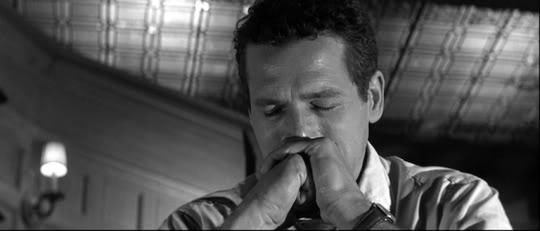
This twenty-minute tour-de-force, where Fast Eddie and Fats play a grueling 36-hour match in a dank pool hall in a constantly murky cloud of smoke, greased by endless glasses of scotch, is a masterpiece of acting and camerawork.  Newman comes on so strong in this scene; endlessly cocky, even when faced with the fact that he’s lost thousands upon thousands of dollars that he could have previously walked away with.  Fats is played by Jackie Gleason of The Honeymooners fame, who plays against type (thank God), never smiling and never giving in to The Hustler’s cajoles and excuses.  Amidst the sounds of balls being pocketing, glasses clinking and pool cues tapping, Felson loses himself in booze and pride and ends up losing everything.

A shamed, broken man he heads west again, but meets college-student alcoholic Piper Laurie in a bus station and uses his charm to move in with her.  The two get along well, yins for each others’ yangs, but easily-got money (and the oft-referenced glory of the pool halls) are two things Felson realizes he can’t live without. An offer by slimy, heartless businessman Bert Gordon, played by a young George C. Scott, to be Felson’s manager, sharing in profits that he hustles while on the road, won’t leave his mind and he accepts – despite the positively indecent 75/25 rate.

“Better to get 25 percent of something than 100 percent of nothing,” Felson says.

After a lavish party thrown by a Mr. Findley in Louisville (played by Murray Hamilton of Jaws’ stubborn Mayor fame) Felson learns how far he’s fallen and just how important the game of pool and his perfection of the art of hustling are compared to losing those that care for him most and, maybe, his very soul.

Newman’s concluding portrayal of a mistake-filled man seeking redemption, while not as powerful as his “Fast” Eddie magnetic charisma, charm and guile seen at the film’s beginning, is another example of the heroic template of characters he will play following 1961; characters that not only are likeable and enviable, but have a heart to match.

George C. Scott’s portrayal of Bert Gordon is a lesson in how to be apparently suave, but always conniving.  Minnesota Fats’ pathetic look in the face of Scott’s infamous bellowing is hard to forget, showing how the best pool player in the world is still nothing but a pawn in the hands of the businessman, the gambler that gambles only when he knows he’ll win – the man with the pocket book.

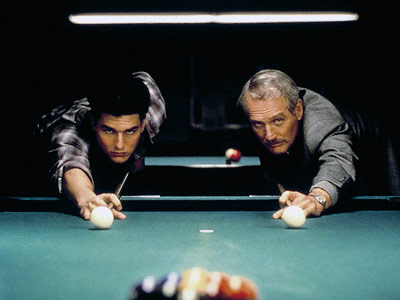
The Hustler doesn’t transition perfectly into Scorsese’s 1986 companion piece The Color of Money, at the end of The Hustler he’s in near-tears, a wreck, and at the beginning of The Color of Money he’s flirting with his blond girlfriend, but I think this is to both films’ strengths.  The former is a dark character piece on a troubled but gifted shyster, the latter on a man who forgot how good he is, and only sees this again when he joins up with a kid who reminds him of his former self (Indeed, if anyone during the Eighties could match Paul Newman’s Sixties pretty-boy exuberance and charisma, it’s Cruise).

They are two completely different films, and yet if The Color of Money is indeed taken as a sequel, then it’s possibly one of the best sequels ever made, and made 25 years after it’s progenitor.  This is in no small part due to how it respects the landmarks The Hustler set up; likewise thrives on its understated themes.

Images courtesy of  image3.examiner.com/ and www.insidesocal.com/outinhollywood/ respectively.

Cassandra’s Dream (2007)


Ewan McGregor, Colin Farrell, Tom Wilkinson, Haley Atwell, Sally Hawkins

Written and Directed by Woody Allen

Following Match Point (2005), without a doubt my favorite Woody Allen movie after Crimes and Misdemeanors (1989), Allen reunited with gorgeous Scarlett Johansson for the travesty that was Scoop (2006) and then made Cassandra’s Dream the next year, staying in England to shoot.

Cassandra’s Dream seems to be a hole-in-the-wall for most critics, mostly due to the fact that its storyline meanders down the same path between violence, choice and the strength, or weakness, of family as does Sidney Lumet’s Before the Devil Knows You’re Dead (also 2007).  The latter is purported to be the better movie by virtually all big-name critics, and I’m not one to argue, but Cassandra shouldn’t be left adrift in favor of barely-better film unfortunately released in the same year.

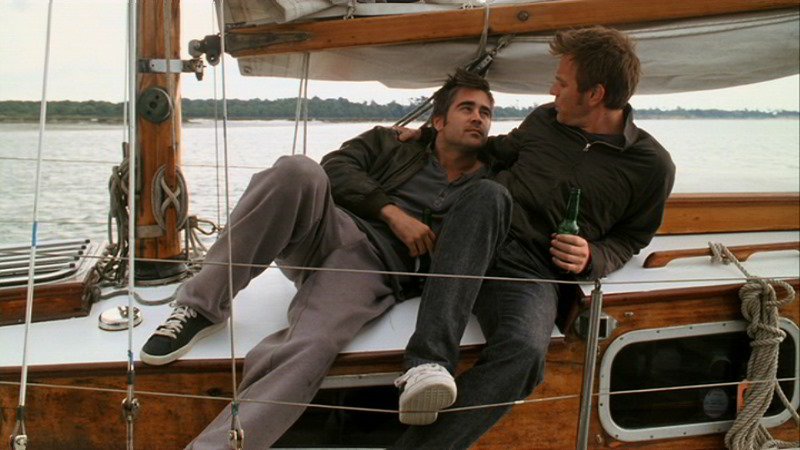
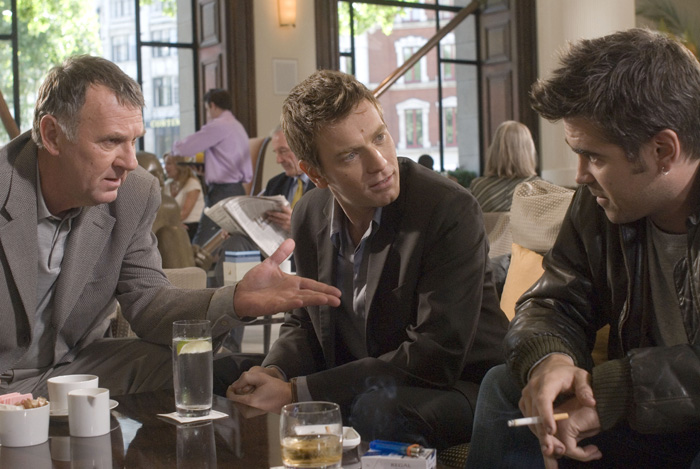
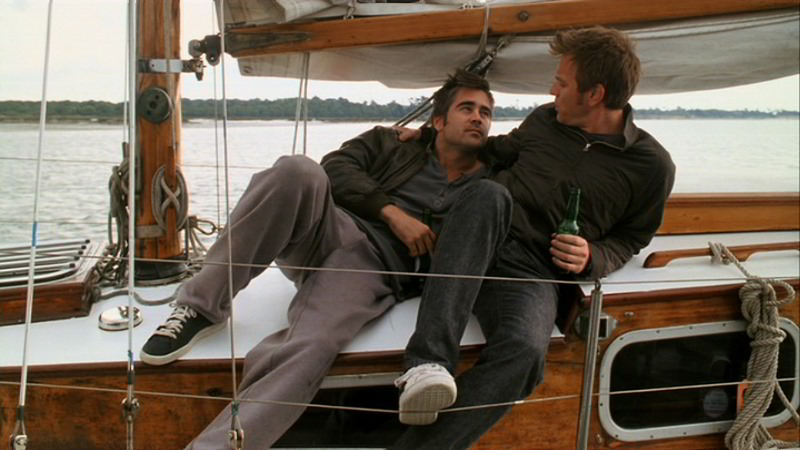
Blue-collar gambler/drinker Colin Farrell and easily-dazzled, wishing-he-was-a-big-shot Ewan McGregor are brothers in suburban London, content with the small things in life, like a nice boat they just splurged on, thanks to the winning streak that Farrell had accumulated at the dog races.  But money proves to be of lingering importance, a theme in many Allen movies, and the boys take advantage of a reunion with wealthy plastic surgeon uncle Tom Wilkinson, in from L.A. for the week.  What they don’t expect is that old uncle has a proposition for them that they didn’t expect, but promises the solution to all their money woes.

The climax of the film involves the perpetration of this proposed deed, and from there a film that had prided itself on its symbiotic success of great writing and great actors’ delivery of such writing somewhat dissolves.  McGregor easily forgets the deed, his mind flush with thoughts of imminent success and pleasing his new, gorgeous actress girlfriend, played by Atwell. But Farrell not so much, and he proves to be a convenient moral thorn in the side of McGregor and Wilkinson, which leads to a much-rushed and also convenient ending aided by yet another murderous proposition by the good uncle.

The film could have afforded an extra fifteen or twenty minute lengthening, to fill in the gaps of the too-rushed conclusion, and to allow more time to develop the agonizing choice McGregor’s character is facing, achieved expertly by Jonathan Rhys-Meyers in the conclusion/resolution of Match Point.

It’s a shame when films dissolve, albeit quickly, towards the end, and I’m usually at a loss as to what causes this, whether it be pestering producers, bad weather, actor/director scuffles or illness. Cassandra’s Dream (the name of the sailing vessel that begins and ends the film) is a good movie, but only a decent one in the prestigious filmography of Woody Allen.  It has all the makings of an excellent film: great, exciting writing, vivacious young actors who love their job, theme-filled plots of the bonds of blood and the allure of becoming rich, and the always-engrossing choice that inevitably makes or breaks the protagonist(s).

But Before the Devil Knows Your Dead, with Philip Seymour Hoffman and Ethan Hawke as the brothers, does the same thing, but with more choice, more thematic plot, and more inescapable tragedy, but only does it better.  It’s s shame Cassandra’s Dream can only be discussed anymore through that lens, but such a thing can easily happen if the navigation one followed through half the movie is cast off (or lost in storm) before the ending.

Image courtesy of http://www.dvdbeaver.com/film2/DVDReviews37/cassandras%20dream%20woody%20allen/cassandras%20dream%20PDVD_015.jpg

Design a site like this with WordPress.com
Get started